Acer Nitro 16 Ai First Look: Unboxing and Impressions
Introduction
The Acer Nitro 16 Ai arrives as the latest entry in Acer’s value-oriented gaming and productivity line, carrying the Nitro name into a 16-inch form factor and incorporating on-device AI capabilities that many buyers now expect. This first-look article covers the unboxing experience, build and design impressions, display and input quality, ports and expandability, real-world performance expectations, thermals and battery life observations, and practical buying guidance for different types of users. The goal is to give readers a clear, practical sense of what to expect from this laptop in everyday scenarios—studying, working, content creation, and gaming—so they can decide whether it fits their needs.
Unboxing and First Impressions
Out of the box, the Acer Nitro 16 Ai presents a straightforward, no-frills unboxing typical of mainstream gaming laptops. The unit arrives in a compact box with minimal packaging layers: the laptop itself wrapped in a soft sleeve, a power brick and cable, and a small packet with documentation and warranty information. The power brick is noticeably larger than ultraportable chargers, reflecting the power demands of a 16-inch gaming-capable chassis.
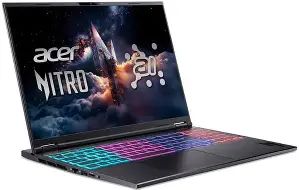
Initial physical impressions are practical rather than premium. The chassis uses a mixture of textured plastic and brushed finishes with Nitro’s design language—subtle angular lines and a focused aesthetic rather than flashy RGB overuse. The lid opens smoothly, and the hinge feels stable enough for single-handed opening on a desk. The weight and footprint make one aware this is a portable desktop replacement rather than a commuter ultrabook.
Design and Build Quality
The Nitro 16 Ai balances durability with cost-effectiveness. The exterior is robust to the touch but does not aim for aluminum unibody refinement; expect a mostly plastic construction with reinforced areas around the keyboard deck. This choice keeps price and weight competitive while preserving rigidity where it matters. The lid resists light flex and the keyboard deck is solid under normal typing pressure.
Design accents are subtle: a slightly chamfered front edge for airflow, a centered logo on the lid, and discreet Nitro branding on the chassis. Venting is clearly prioritized at the rear and sides, indicating that Acer expects sustained workloads—games and content creation—to be typical use cases.
Weight and Portability
At ~16 inches of screen real estate, the Nitro 16 Ai is not the lightest machine. It sits in the middle ground: heavier than ultraportables but lighter than many full-size gaming rigs. This makes it suitable for users who move between home and campus or occasionally travel, but those who prioritize strict carry weight should consider smaller, lighter alternatives.
Display and Audio
The 16-inch display is a key selling point. On machines in this class, buyers typically choose between faster, lower-resolution panels for gaming and higher-resolution, color-accurate panels for creative work. The Nitro 16 Ai is offered with options that reflect this split: high refresh rate panels that deliver smoother gameplay, and more color-oriented panels better for photo and video editing. In practical use, the display delivers punchy colors and adequate brightness for indoor use. Viewing angles are solid, and the extra screen area improves productivity versus a 15.6-inch laptop.
Speakers on the Nitro 16 Ai are adequate for casual media consumption and conference calls, with decent mids and highs but limited bass. For immersive gaming or serious media work, an external speaker or headphones is recommended.
Keyboard, Trackpad, and Input
The keyboard is a strong point for daily use. Keys have a medium travel that suits both typing and gaming sessions. Layout is ergonomic, with full-size arrow keys and an optional numeric keypad depending on the exact model configuration. Keycaps are slightly textured, which helps during long sessions. Backlighting is present—often red or white in Nitro models—making late-night work easier.
Find top-rated Laptops & Computers products at great prices.
Browse Now →The trackpad is large and responsive, supporting multitouch gestures. It’s not clicky like dedicated mechanical input devices, but it’s precise enough for navigation and light editing work. Gamers will still prefer a mouse for competitive play.
Ports and Expandability
Acer typically outfits its Nitro line with a practical selection of ports to satisfy gamers and creators alike, and the Nitro 16 Ai follows that pattern. Expect a mix of USB-A and USB-C ports, an HDMI output for external displays, an Ethernet jack for stable networked gaming, and a 3.5mm audio jack. The inclusion of both USB-C with DisplayPort alt-mode and full-size HDMI makes connecting to dock setups and external monitors straightforward.
On the expansion side, many configurations allow upgrading RAM and storage via accessible panels under the chassis. This is particularly useful for buyers who plan to extend the laptop’s usable life by adding an SSD or increasing memory later. Always confirm the specific model’s serviceability before purchase, since configurations and internal access can vary by SKU.
Performance and Real-World Use
Performance impressions depend heavily on the chosen configuration. The Nitro family typically offers both Intel and AMD CPU options paired with midrange to upper-midrange discrete GPUs. In everyday productivity—web browsing, Office work, video calls—the Nitro 16 Ai is more than capable. It handles multiple browser tabs, document editing, and light photo editing without a hiccup.
For creative workloads like photo editing and 1080p video timelines, the machine is comfortable when equipped with a stronger CPU and sufficient RAM. The larger screen and higher resolution options are beneficial for timeline and dual-window workflows. When it comes to heavier tasks—4K video export, large rendering jobs—users should temper expectations: while the Nitro 16 Ai can handle these tasks, high-end mobile workstations will complete them faster due to more powerful CPUs and professional GPUs.
Gaming performance is where the Nitro series has always focused. In modern AAA titles, the Nitro 16 Ai performs well at 1080p on medium to high settings on configurations with discrete GPUs. Fast refresh-rate panels paired with capable GPUs deliver smooth gameplay for competitive titles. Thermal limits and power budgets mean ultra-high frame rates at max settings across the newest titles will be constrained compared to desktop GPUs, but the laptop strikes a sensible balance between performance and thermals.
Thermals and Noise
Thermal management is competent. Under sustained load, fans ramp up perceptibly but remain within expected noise levels for gaming laptops. The chassis design channels hot air out the rear and sides effectively, keeping key areas like the keyboard and palm rest cooler for long sessions. That said, under heavy CPU+GPU loads, users will notice fan noise and some surface warmth—normal for the segment.
Battery Life
Battery life is typical for a 16-inch gaming-capable laptop: enough for a few hours of productivity on balanced settings, but limited for extended mobile work without charging. Real-world usage—browser sessions, document editing, and video playback—may extend runtime modestly if the discrete GPU remains idle and power-saving settings are used. Buyers who need all-day unplugged operation should consider models emphasizing efficiency or carry the charger.
Software and AI Features
The "Ai" designation in the model name highlights on-device AI features aimed at improving workflow and gaming quality. Expect software utilities that optimize performance modes, manage network prioritization for gaming, and possibly include AI-driven noise cancellation for microphones and background removal for video calls. These features are practical: they can reduce setup friction for streaming, improve call clarity, and offer automated adjustments for power and thermals. As with any OEM software, users should evaluate which tools they keep enabled, since some utilities run in the background and affect performance or battery life.
Discover deals on Laptops & Computers — updated daily.
See Deals →Real-World Use Cases
The Nitro 16 Ai is aimed at buyers who need a multi-purpose machine: a capable gaming laptop that doubles as a productivity and content-creation device. Common buyer profiles include:
- Students who want a laptop for classes, note-taking, light creative work, and occasional gaming between study sessions.
- Casual and competitive gamers who need good 1080p gaming performance with a high refresh-rate display for esports titles.
- Content creators on a budget who edit photos and 1080p video and appreciate larger screen real estate for timelines and color work.
- Hybrid workers who require a single device for remote meetings, office apps, and multimedia consumption, and value a strong webcam and microphone setup.
Pros & Cons
- Pros:
- Practical 16-inch display that balances productivity and gaming.
- Good value proposition: strong performance for everyday tasks and gaming in a competitive price band.
- Solid keyboard and input quality for long typing sessions.
- Practical port selection including HDMI, Ethernet, and USB-C.
- Serviceable internals in many configurations—RAM and storage upgrades possible.
- On-device AI features that can simplify tasks like noise cancellation and performance tuning.
- Cons:
- Chassis materials are mostly plastic, so it doesn’t feel as premium as metal alternatives.
- Battery life is limited under heavy use; not ideal for prolonged unplugged productivity.
- Thermals and fan noise become noticeable under heavy sustained loads.
- Speakers are adequate but not exceptional for immersive audio without headphones.
Quick Comparison: Typical Configurations
| Configuration | CPU | GPU | Display | RAM | Storage | Use Case |
|---|---|---|---|---|---|---|
| Base | Entry-level Core/Ryzen (quad/6-core) | Entry-level discrete GPU | 1080p, 60–144 Hz | 8–16 GB | 256–512 GB SSD | Students, light gaming, everyday productivity |
| Mid | 6–8 core Core/Ryzen | Midrange RTX-class / equivalent | 1080p, 144–165 Hz (better color) | 16 GB | 512 GB – 1 TB SSD | Mainstream gaming and content creation |
| High | 8+ core Core/Ryzen | Upper-mid discrete GPU | Higher refresh or higher resolution panel | 16–32 GB | 1 TB+ SSD | Serious gaming, heavier editing |
Buying Guide: How to Choose the Right Nitro 16 Ai
Choosing the right configuration depends on how the laptop will be used. Below are practical recommendations based on common priorities.
For Students and General Productivity
- Prioritize a balanced CPU and at least 8—preferably 16—GB of RAM to handle multitasking and browser-heavy workloads.
- Choose a 1080p panel with 60–144 Hz for sharp text and acceptable battery life.
- Storage: 256–512 GB SSD is fine to start; verify upgradeability if more space is needed later.
For Gamers
- Invest in a discrete GPU that matches desired frame rates at 1080p; midrange GPUs are the best value for most gamers.
- Match the display refresh rate to the GPU’s expected output—144 Hz or higher if competitive gaming is a priority.
- Consider at least 16 GB of RAM to future-proof and avoid bottlenecks in modern titles.
For Content Creators
- Choose higher RAM (16–32 GB) and a larger, faster SSD for timeline performance and scratch space.
- Prefer display options with better color coverage (sRGB/Adobe RGB) if color accuracy matters.
- When possible, balance CPU and GPU choice toward the workload: CPU-heavy for encoding and GPU-accelerated for certain effects.
Portability vs. Power
If portability is critical, consider smaller, lighter laptops; the Nitro 16 Ai offers more power at the cost of weight. If frequent travel is a priority, check the exact weight and battery specifications and balance them against the performance needed.
Warranty and Support
Check local warranty coverage and optional protection plans; gaming laptops often receive heavy daily use and accidental-damage coverage can be beneficial. Also look for after-sales software updates, especially for firmware and GPU drivers that can affect performance and thermals.
Final Thoughts and Conclusion
The Acer Nitro 16 Ai is a thoughtful evolution of the Nitro line, aimed at users who want a versatile 16-inch laptop that can handle gaming, study, and creative work without a premium price tag. Its strengths are pragmatic: a comfortable keyboard, a flexible display choice, solid port selection, and serviceable upgradeability. On-device AI features add convenience for conferencing and everyday workflows, and the overall package is compelling for anyone seeking a multi-purpose portable desktop replacement.
However, buyers should be realistic about trade-offs. The chassis material and speakers reflect the value-oriented positioning, battery life won’t match ultraportables, and intensive workloads will push thermals and fan noise. For students, casual gamers, and creators on a budget, the Nitro 16 Ai hits an attractive middle ground. For professionals who need the absolute best thermals, battery, or premium build, higher-end workstations or ultraportables may be a better fit.
In summary, the Acer Nitro 16 Ai is a strong contender in the midrange 16-inch market: practical, adaptable, and designed for real-world use where performance and value matter more than headline luxury finishes. Prospective buyers should choose a configuration aligned with their primary use case—balancing CPU, GPU, RAM, and display—and consider serviceability for future upgrades to extend the machine’s lifespan.